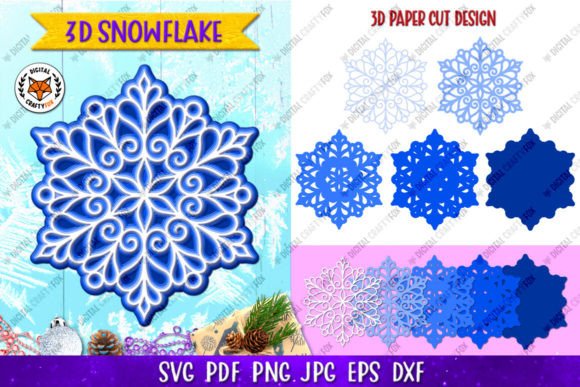
Evaluating the 3D Snowflake Paper Cut Layered SVG for Professional Crafting
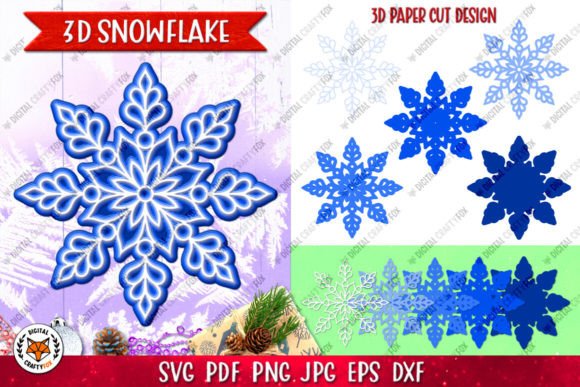
The market for digital cutting files is saturated with simple, single-layer designs that often lack the depth required for premium holiday decor. For creators and small business owners seeking to elevate their product offerings, the 3D Snowflake Paper Cut Layered SVG represents a shift toward dimensional complexity. This specific asset is not merely a flat vector; it is a structured, five-layer architectural design intended to produce a tangible, three-dimensional ornament. Understanding the technical specifications and practical applications of this file set is essential for determining its viability in a professional workflow, whether for laser cutting, paper crafting, or sublimation projects.
Technical Composition and File Versatility
The primary value of any digital design asset lies in its interoperability across different hardware and software ecosystems. This 3D layered Christmas ornament package addresses compatibility through a comprehensive suite of formats. The inclusion of DXF, SVG, EPS10, PDF, JPG, and PNG files ensures that users are not locked into a single machine brand or design program.
- Vector Formats (SVG, DXF, EPS10): These are critical for users operating Cricut, Silhouette, Brother ScanNCut, or Glowforge machines. The SVG format retains editability in Adobe Illustrator and Inkscape, allowing professionals to resize the 864x864 pixel base art without loss of fidelity. The DXF file serves as a universal fallback for older cutting software or industrial laser cutters that may struggle with SVG parsing.
- Raster Formats (PNG, JPG): Provided at 3600x3600 pixels and 300 DPI, these high-resolution files serve a dual purpose. They are suitable for sublimation printing onto ceramic or metal ornaments, where the 3D effect is simulated visually rather than physically. The transparent PNG background is particularly valuable for integrating the snowflake design into composite digital layouts or print-on-demand merchandise without tedious masking.
- PDF Documentation: The 300 DPI PDF on a transparent background acts as both a printable template and a reference guide. For hand-cutters or those verifying scale before committing expensive materials, this format provides a reliable visual check.
This multi-format approach reduces friction in the production pipeline. A freelancer can use the same purchase to create physical paper ornaments for a local market and digital greeting cards for an online client, maximizing the return on investment for a single asset.
Structural Integrity of the Five-Layer Design
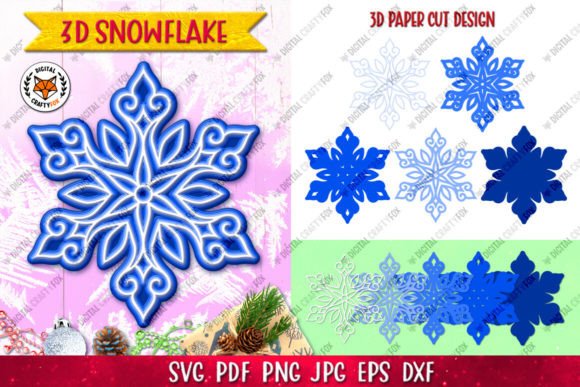
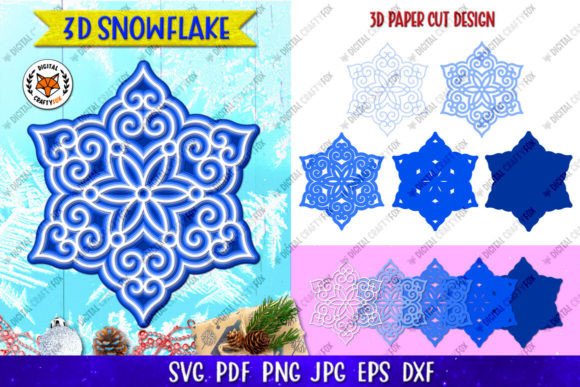
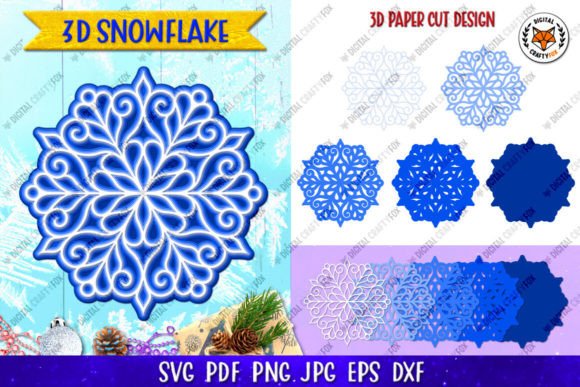
Creating a successful 3D paper cut requires more than stacking shapes; it demands precise registration and intentional spacing. This design utilizes five distinct layers to achieve its volumetric effect. From a manufacturing perspective, this layer count strikes a practical balance. Three layers often appear too flat to justify the assembly time, while seven or more layers can become prohibitively thick for standard ornament hooks and difficult to align manually.
The five-layer configuration allows for significant shadow play when backlit or displayed near tree lights, which is the defining characteristic of quality paper cut art. For laser cutter operators, this structure necessitates careful power and speed testing. The intricate internal geometry typical of snowflake patterns means that excessive heat can cause charring on the inner edges. However, because the files are provided as separate layers rather than a merged image, users can optimize cut settings for each tier individually if variations in material thickness occur.
For hand cutters, the inclusion of dedicated hand-cutting files is a significant usability feature. Machine-optimized vectors often contain thousands of microscopic nodes that make scissor or knife work impossible. Dedicated hand-cutting templates usually simplify these paths while retaining the visual essence of the design, acknowledging that not all artisans rely solely on automation.
Material Selection and Production Considerations
The performance of the 3D Snowflake Paper Cut Layered SVG is heavily dependent on material choice. While the design is versatile, professional results require matching the substrate to the intended application.
Paper and Cardstock
For traditional paper cutting, cardstock weight is the most critical variable. Text-weight paper (under 80gsm) lacks the rigidity to support five layers and will sag, destroying the 3D illusion. Conversely, heavy cover stock (over 110lb/300gsm) may be too thick for intricate interior cuts, leading to tearing or blade drag. A mid-weight cardstock between 65lb and 80lb cover (176–216 gsm) typically offers the optimal compromise of stiffness and cuttability. Foam tape or adhesive dots are necessary spacers; applying glue directly between layers will compress the design and negate the depth effect.
Laser Cutting Materials
Basswood veneer (1/32" or 0.8mm) and acrylic are excellent alternatives to paper for permanent ornaments. Acrylic, in particular, benefits from the layered design when using contrasting colors or translucent tints. However, users must account for the kerf (laser beam width). Intricate snowflake lattices can fuse together if the design was not kerf-compensated. It is advisable to perform a test cut on scrap material to verify that the negative spaces remain open after burning.
Sublimation Applications
When utilizing the high-res PNG for sublimation, the "3D" aspect becomes an optical simulation. To enhance this, designers should consider adding a subtle drop shadow within their RIP software or design editor before printing. This reinforces the perception of depth on a flat surface. The 300 DPI resolution at 3600px ensures crisp edges even on large-format transfers, preventing the pixelation that often plagues lower-quality marketplace assets.
Commercial Viability and Workflow Integration
For entrepreneurs and Etsy sellers, time-to-product is a key metric. This asset supports batch processing efficiently. Because the layers are pre-separated, there is no need to spend hours ungrouping or reconstructing the z-axis hierarchy in cutting software. This plug-and-play readiness allows for rapid prototyping and listing creation during the high-pressure Q4 holiday season.
However, users must manage expectations regarding color accuracy. As noted in the product specifications, discrepancies between screen display and physical output are inevitable. RGB monitors emit light, while printed ink and dyed paper absorb it. Professionals should always run physical proofs before accepting bulk orders. If using the sublimation files, ICC profile calibration is mandatory to ensure the whites remain pure and the blues do not shift toward purple or green. For paper crafters, sourcing consistent cardstock batches is equally important to maintain uniformity across a product line.
Assessing Value and Limitations
While the 3D Snowflake Paper Cut Layered SVG is a robust tool, it is not without limitations. The fixed 864x864 pixel dimension for vector files is adequate for most ornament sizes but may require node cleanup if scaled up significantly for wall art or window displays. Vector scaling is mathematically infinite, but artistic integrity depends on stroke width ratios. Enlarging the design by 400% might result in disproportionately thin structural elements that fail during cutting or assembly.
Additionally, the complexity of five layers increases assembly time compared to flat designs. For high-volume production, labor costs must be factored into pricing. Jigs or alignment templates (which can be created from the included PDF or DXF) are highly recommended to reduce waste and improve consistency. Without a jig, manual alignment of five intricate layers can lead to a high rejection rate.
Despite these considerations, the asset delivers substantial utility. It bridges the gap between digital convenience and artisanal quality. The provision of hand-cutting files alongside machine vectors demonstrates an understanding of the hybrid maker community. The high-resolution raster options extend the product's lifecycle beyond the physical cutting niche, offering flexibility for mixed-media creators.
Making an Informed Decision
This digital download is best suited for intermediate to advanced makers who understand the relationship between file preparation and physical output. Beginners may find the five-layer assembly challenging without prior experience in dimensional paper crafts. Conversely, seasoned professionals will appreciate the clean file structure and format variety that streamlines their existing workflows.
If your goal is to produce distinctive, textured holiday decor that stands apart from generic flat vinyl stickers, this layered SVG provides the necessary foundation. Its success ultimately depends on the user’s willingness to test materials, calibrate equipment, and invest the time required for precision assembly. When executed correctly, the result is a professional-grade ornament that justifies a higher price point and enhances brand perception. For those who find value in this resource, leaving a rating helps maintain the ecosystem of quality digital assets, guiding future buyers toward reliable tools. Should technical issues arise regarding file compatibility or layer alignment, direct communication with the creator remains the most effective path to resolution.